

2026 WinnerGatineau region
Verify ↗Wood fence installation in Gatineau and Ottawa
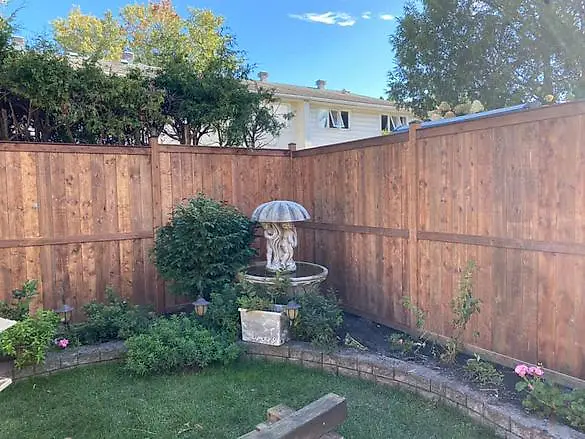
Cedar or pressure treated. Horizontal slats or vertical boards. Posts set below the frost line. 5 year warranty on the installation.

- Warranty on the installation5 years
- Visit and written quoteFree
- Bilingual serviceEN / FR
The real failure point
A wood fence does not fail at the boards. It fails at the posts.
The ground here freezes deep every winter. Water in the soil expands as it freezes and pushes up on anything that is not anchored below that line. That is frost heave.
A post set above the frost line lifts a little the first winter, a little more the second, and never settles all the way back. After two or three winters the fence line waves, the gate drags on its frame, and boards split where the tension builds. The wood itself is often still fine. The footing moved.
So we dig below the frost line, put gravel in the bottom of the hole so water drains away, and anchor every post. That part of the job disappears the day the boards go on. It is also the part that decides whether the line is still straight ten years from now.
What you get
What actually gets built on your property
It is all written into the quote, line by line. You know the wood, the height, how many posts and how many gates before anything starts.
Cedar or pressure treated
Pressure treated costs less and is made to sit against damp soil. Cedar is more stable, twists and splits less over the years, and greys to an even tone if you leave it bare. We show you both during the visit, with the price difference.
Horizontal slats or vertical boards
Horizontal reads modern and stretches the yard visually. Vertical is the classic neighbourhood look. Both last just as long. The post decides that, not the direction of the boards.
Full privacy or spaced
Boards tight together for a solid screen, spaced to let air and light through, or staggered on both faces of the frame so the view is blocked but the wind still passes.
Height that fits your by-law
Fence by-laws differ between Quebec and Ontario, and between municipalities. We confirm the rules that apply to your address before we start. That happens before any material is ordered.
Posts set below the frost line
Hole dug to depth, drainage gravel in the bottom, post aligned and plumb. This is the line in the quote we do not cut.
Gates and hardware
Single, double, or wide enough for a vehicle. Braced frame so it does not sag, adjustable hinges and a latch. Set up to keep closing as the wood moves.
Old fence taken out
If you are replacing, we pull the old one, posts and concrete included, and haul it away. It is priced on its own line so you see exactly what it costs.
Yard left clean
Soil put back around the posts, offcuts and old material picked up. You get the yard back usable, not as a work site.
What drives the price
The four things that move the number
We will not give you a figure over the phone without seeing the ground. A made up range does not help you decide, and it ends up wrong in one direction or the other.
Length
Linear feet is the first factor. It sets how much wood you need and, more to the point, how many post holes get dug. Digging is the long part of the job.
Material and style
Cedar costs more than pressure treated. A solid privacy screen takes more boards than a spaced fence. Height moves the number too, at the same length.
Number of gates
Every gate is a built piece: frame, hardware, hanging and adjustment. Two gates change the price far more than another ten feet of fence.
The ground
A slope, rock, roots, or a narrow side access to the back yard all add digging time. That is exactly what we look at on site.
The visit is free. The quote is free, written and itemized. You get a firm price instead of a verbal estimate, and there is nothing to sign that day.
After the install
5 year warranty, and financing if you want it
5 year warranty on the installation
In writing, in the quote. It covers the installation itself: the posts, the alignment, the hardware and the workmanship, for 5 years. A post that moves or a gate that stops closing properly, we come back.
What it does not cover
Damage from an impact, from an exceptional storm, or from a change someone else made to the fence. We say that up front and write it down, not in small print at the bottom of a page.
Financing available
A fence is one large purchase for something you keep for a long time. You do not have to pay for all of it at once. See if you pre-qualify before you decide, with no impact on your credit score.
Service in English and French
The whole crew is bilingual, on both sides of the river. You get served in your language, from the first visit to the last gate adjustment.
Common questions
Wood fences, what people ask us
Cedar or pressure treated, which one?
Do you replace old cedar fences?
Do I need a permit for a wood fence?
Why is my wood fence leaning?
Should I stain the wood, and when?
Kevin & his team were very easy to work with and I'm very happy with the result of my new fence. I changed a few things to the original plan and there was no trouble or hassle in doing so. I'm already planning to hire them for another project!
Excellent service from start to finish! The work was completed quickly and with great care. The team is very professional and courteous, and communication was easy throughout the project. I am truly satisfied with the result-I highly recommend them. 5/5
Free quote
Tell us what you have in mind
Other services
Wood may not be the right choice for your yard
Tell us what you are trying to solve. We will tell you straight which material holds up best in your situation.

PVC fence
No maintenance. Does not rot, never needs paint.
See the options →
Chain link
Strong and economical. Galvanized or black, with or without privacy slats.
See the options →
Ornamental aluminum
Clean lines, close to no upkeep. Does not rust, keeps its finish.
See the options →
Pool fence
Enclosure built to the pool safety rules that apply at your address, with self closing and self latching gate hardware.
Check my setup →
Repair
Leaning post, broken panel, gate that will not close. Whoever installed it.
See the options →
Custom gates
Single, double, or wide enough for a vehicle. Solid hardware, set up for winter.
See the options →